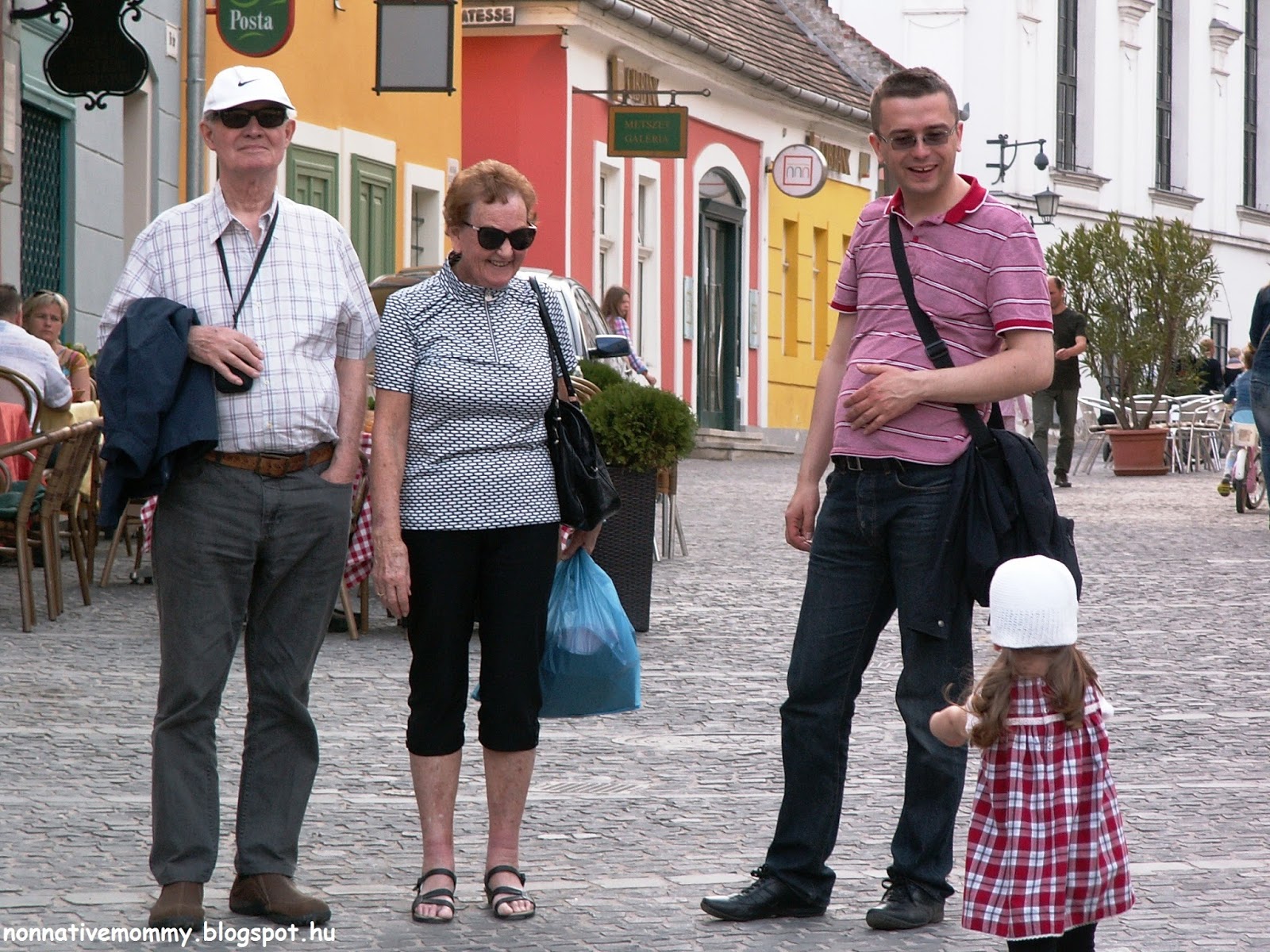
Our Australian friends (who we'd met on our honeymoon in Istanbul) came to Europe for a cruise on the Danube. Their ship left from Budapest and they could visit us as well. They killed two birds with one stone and it was again a great opportunity for E. to "test" her English. (You can read about E.'s 1st real life test here when she met her English speaking cousin)
As soon as M. and B. arrived at our place, M. and E. hit it off. E. wanted to show her room and her kitchen and what she cooked. I was astonished to see it as she is never so open and welcoming to anyone, not to mention a stranger. There was no language barrier as such. It was absolutely natural for her to use English with M.
E. got some sweet presents (soft toys and books) from M. and B, which were all Australia related.
Presents for E. - Books
At first, she was a bit afraid of Jacko and the beanstalk (I guess because of the scary crocodile), but by now she's okay with it.
She really loves to identify the Australian animals in the little booklet in the top right corner. As this book also includes the national anthem, we spent one evening after dinner to listen to it on youtube
(together with several other national anthems, like the British, the US, Irish, Spanish, Colombian and the German)
Toys E. received from M. and B. Her favourite is the platypus (E. named her Platy). And we agreed they can talk in English only. She accepted it without any problem.
So our friends, M. and B., came to our place. I showed them around our area and invited them for a traditional Hungarian lunch (goulash soup, fried chicken breast in bread crumbs, mash potato plus green salad).
E. took a nap and as soon as she woke up we left for Szentendre, a town near to Budapest on the bank of the Danube.
Szentendre in pictures
Just arrived
Main Square
On the bank of the River Danube
We had a wonderful time together. E. proved her great level of English again. We've been enriched with some books on Australia, some stuffed animals from the country and the time spent with this lovely couple.
In short: Nothing. In more details: last month (April) we met a lovely elderly couple from Australia who we'd encountered on our honeymoon in Istanbul in 2011. Quite unusual.
I've taken the opportunity of their visit to Hungary to introduce Australia to E. She loves planet Earth anyway. She already knows about continents (her favourite is Antarctica) so Australia will be fascinating for her. I hoped...
Map of Australia
As E. enjoys looking at maps and our big picture atlas I made a map colouring activity for her. I just printed a blank Australia map with the states drawn on it and after naming each states we coloured them one by one.
E. is practising her A
I also wrote AUSTRALIA below the map and E. traced my letters.
This Australian map puzzle was quite time-consuming to make but the result was beautiful and E. loved it. The link gives you a detailed description how to prepare it. In my version I laminated the pieces. As Queensland and Western Australia consist of 2 parts I sellotaped them together. Then I added sticky back velcro (bought them on sale in Auchan).
The background is a big blue cardboard
sticking
FINISHED!
I couldn't buy a big enough cardboard to fit Tasmania in the right place. What a pity!
We can also use this puzzle map in the long run (I also plan to introduce her some cities as well as animals and famous sights. We'll use this map to pin cities, animals and sights up on it and put it on the wall to display)
She has done the Australian puzzle map several occasions. Sometimes she even said the names of its states.
Painting the flag
As the puzzle map gave me a hard time we did not twist the flag project. I printed a blank Australian flag and painted it while we were talking about what is what on the flag
The British Union Jack flag is in the upper left corner - noting Australia's ties to Great Britain
The Southern Cross constellation (5 stars) is on the right side of the flag. The constellation can be seen from everywhere in Australia
The large, white, seven-pointed Commonwealth Star
Of course, we displayed our pieces on our living-room door. You need to imaging the composition as I've forgotten to take a photo of it.
Work in progress
Let's start!
Animals of Australia
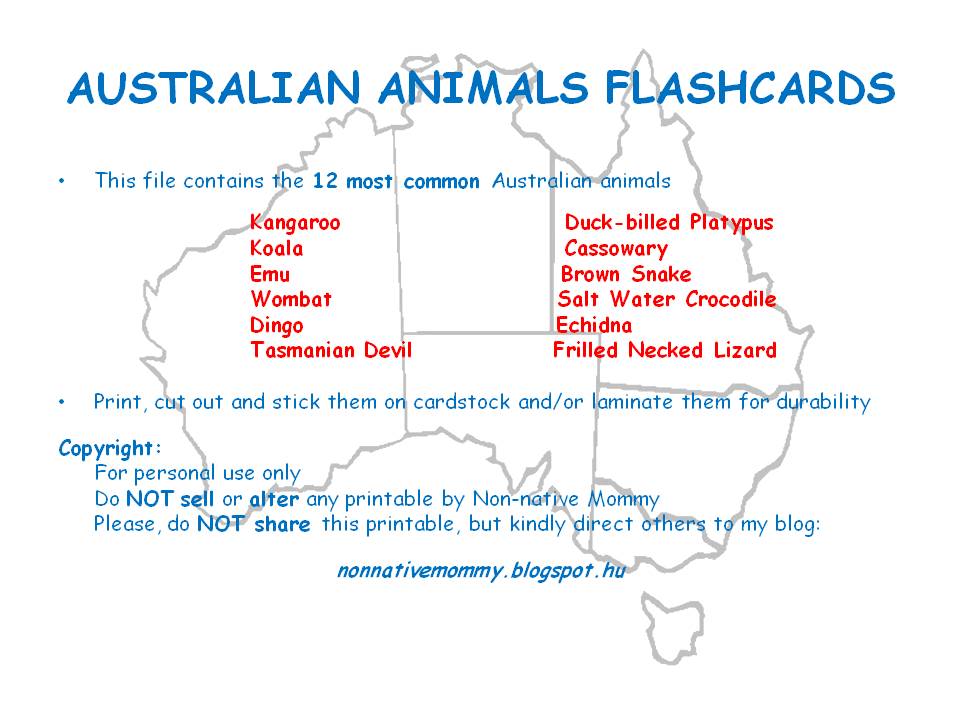
First, I created flashcards of the most commonly known Australian animals. (See a printable at the end of the post)
Kangaroo Duck-billed Platypus
Koala Cassowary
Emu Brown snake
Wombat Salt Water Crocodile
Dingo Echidna
Tasmanian Devil Frilled Necked Lizard
E. has already heard about and seen a kangaroo in the zoo, and also seen pictures of koalas. She knows the (white) wombat from the video titled Red Rabbit, Green Gorilla. She is also familiar with the look of a crocodile or a snake as well as an ostrich, which can remind you of an emu. So first, I showed her 7 flashcards out of the 12.
As most of the animals had a familiar look I decided to add some information to the flashcards on their backs.
We had a look at Australia in our Picture Atlas Of The World.
As on this map flora and fauna is depicted, I showed E. an animal, I said its name and she needed to find it on the map. When she found it we placed the flashcard on the map and I told her some interesting information (1 or 2 pieces) about the animal (eating habit, place of living, offspring etc.)
She was laughing at the platypus and found the Tasmanian Devil cute.
When we finished with this she wanted to see them in real life so we sat down in front of youtube and watched a few interesting videos. (I had prepared for this request so we didn't need to waste time with searching for them)
The Cow Goes Moo - Kangaroo for Kids
I'm a Kangaroo
I'm a Koala
Bindi and Robert Irwin feature huge salt-water crocodile
Platypus: Animals for Children
Bindi and Robert Irwin feature: Wombat
E. was fascinated by the platypus, mainly its webbed feet. So we needed to draw a Mommy and Baby platypus webbed "feet"
We'll have a look at the other animals later.
In the next part:
E.'s 2nd test of her English; the lovely time in Szentendre we spent together with our Australian friends (M. and B.). - You can read about E.'s 1st real life test here
E. got some sweet presents (soft toys and books) from M. and B.
And now here comes the printable Australian animals flashcards:
E. turned 16 months on Monday and I am not exaggerating if I say she can use much more than 100 words in each language (Hungarian and English).
The calculation was done by D. He added up all the functional language (thanking, asking, giving, objecting, greetings etc.) and words of different topics we've been dealing with (see the collection bellow) and the sum must be over 100 words, getting closer to 200.
Now I'm collecting the ones that E. uses confidently in the right context (and not just parroting them or not the ones she understands because in this case there are a thousand words, I guess). Of course, these words and expressions are not 100 % clear. (She tends to pronounce the "k" sound "p", the "g" sound "b" or the vowels sometimes melt into one another). Still, it's her great achievement.
Now I'm trying to focus on her English only:
Peek-a-boo
Functional language:
Thank you
Please
Pick it up
Here you are
There (if she wants to go somewhere)
Let's go
Come on
Bye-bye
Hi/Hello
Don't like it
Like it
Cheers (when drinking)
Up
Out (of the playpen or high chair)
not comfy (on the potty)
Oops (when something is fallen)
Oh, no! (when something goes wrong)
Peek-a-boo (when she hides behind the curtain)
Family members:
mommy
daddy
granny
papa (for grandpa)
baby
+ names of our family members (7 people), our native nanny (A.) and my best friend (B.)
Animals: (if she doesn't know the name of the animal she says the sounds they make)
doggie
Our poor mixed-breed
froggie
cat/kitty
cow
sheep
kangaroo
hippo
bear
mouse
rat
panda
butterfly
ladybird
bee
pig
duck
ant
turtle
whale
dino
Fruit:
Window pictures
apple
pear
grapes (a bunch of grapes)
banana
kiwi
orange
plum
lemon
cherries
strawberries
apricot
peach
tomato
berry
Vegetable:
aubergine
onion
potato
broccoli
mushroom
pumpkin
Other foods:
water
cheese
bread
salami
sausage
honey
water
milk
mayonnaise
ketchup
butter
yogurt
coffee
ice creme
ricecake
Flowers:
peony
lilac
begonia
pansy
daisy
Flag of Portugal - E.'s favourite right now
Countries/Flags/:
Norway
Belgium
Portugal
Hungary
the European Union
Turkey
Italy
Colours: (the clearest utterances)
red
orange
yellow
green
blue
purple
pink
black
white
grey
Bubbles
brown
Shapes:
oval
triangle
heart
star
pentagon
rectangle
Everyday object/Toys:
spoon
plate
knife
fork
bottle
kitchen
teddy
book
playground
sandpit
bath
colour pencil
drawing star
crayon
paper
drawing
nappy
creme
toothbrush
man (a plastic figurine)
clock
high chair
door
playpen
Sandpit
video
dummy
potty
poopy
pee pee
peg
mill
car
choo-choo train
ball
puddle
big
bubbles
bin
balloon
sun
cloud
Hat and jeans
Clothes:
jacket
slippers
hat
trousers
jeans
shoes
cardigan
boots
pyjamas
socks
Body parts:
head
pinkie
nose
ear
knee
mouth
toe
eyes
Musical instruments: (she's not so intereted in this topic although she is quite musical)
drum
piano
Breeds of dog: (I introduced some dog flashcards 3 days ago)
Westie
Shar-pei
bulldog
puli
mixed breed
E. is making up more and more combinations, like big puddle, red pinkie (for polished fingernails), purple plum, pencil drawing, banana yogurt, black doggie etc.
If it goes like this, in two more months she'll say sentences. She's amazing, a little genius. Am I proud? Hard to say how much :)
Going to the zoo was always my favourite activity as a child (still love it today) so I could hardly wait for E. to get at least a little bit interested. And the time has come.
Our first time to the Budapest zoo was when she was 6 months old. It was more fun for me than for her. She had a look at the camels (and smiled when saw them pee) and the farmyard and then fell asleep. She only woke up for nursing (which I managed in the disabled loo) then went back to sleep again.
But now as she is over 1 (15 months old more precisely) she takes pleasure in walking around and looking at animals.
Visiting relatives in Debrecen gave us the sudden idea to visit the zoo there. It was actually a great idea. We all loved it. We were already in the zoo for half an hour (saw some parrots, giraffes and monkeys) when I realised what a good occasion would this be to use English (our Hungarian relatives didn't accompany us). So we just sang our song to signal the change in using languages and continued our animal adventure in English.
As we were walking around, we described everything to her in English (and as usual she was repeating everything like a parrot):
what animals we saw (turtles, a hippo, penguins - her favourites, more monkeys, laughing doves, roosters and hens, camels, goats, ostriches and lions)
what they looked like ("Look, the camel has two big humps"; "Wow, this rooster has a huge red comb on his head")
what sounds they gave (roar, squeak, cock-a-doodle-do, coo-coo etc.)
what the animals were served for dinner (fruits, vegetables, mouse, rabbit etc.)
"Pat, pat - rabbit"
At the end of our visit we found a wooden playground where there were a lot of animals. E.'s favourite was the caterpillar. She climbed on it and rode it for about 15 minutes. We also counted and named the caterpillar's legs, eyes, mouth and antennae.
Our second English tour in the zoo was in Budapest with our native nanny, A. I learnt some new animal names (e.g.:cassowary) and we had a wonderful day with a lot of English (I tried to stay in the background and let A. and E. interact with each other a lot). The photos speak for themselves.
E.'s favourite place was the Butterfly House, where we could see how butterflies come out of their pupa, and of course, there were plenty of different types of butterflies flying around, eating oranges or just resting on the plants. We had to go back once again before leaving the zoo. E. was running around and one could see on her little face how amazed she was. Her favourite animals are butterflies at the moment.
Morpho peleides butterfly - blue on the inside
E.'s pointing at the butterfly she liked the most, saying: "orange"
After the zoo experience I found a nice page where the metamorphosis of a butterfly can be seen quite nicely. So I printed it and E."coloured" it :) with my help.
We also watched the seal show at 11 o'clock. A big crowd gathered to see the seals but everything was explained in Hungarian only. (Sorry A., I didn't interpret it at all :( )
E. was fascinated by the ball (and not the seal...)
Baby Giraffe
E. was sleeping when we went to see the Neanderthals. It's a relatively new exhibition of a (wax) neanderthal family. This little boy with the cave drawing was my favourite.
After E. woke up we had some lunch (vegetable dish for E. and sandwiches for A. and myself - I wish E. hadn't said "people" for the first time while I put a spoonful of her dish into her mouth)
Flamingoes
We also went to see the baby elephant, but E. was more interested in a turtle shell:
Another favourite place was the traditional Hungarian farmyard. Rabbits were E.'s favourite. We had to return here as well for a second visit. E. was repeating the words like "rabbit", "hop", "carrot" and "apple" all the way through. E. had an incident with the foal, which wanted to her shoes.
All in all, we enjoyed ourselves to a great extent and will return to practise our English as well as having fun around "amimals" - as E. says.