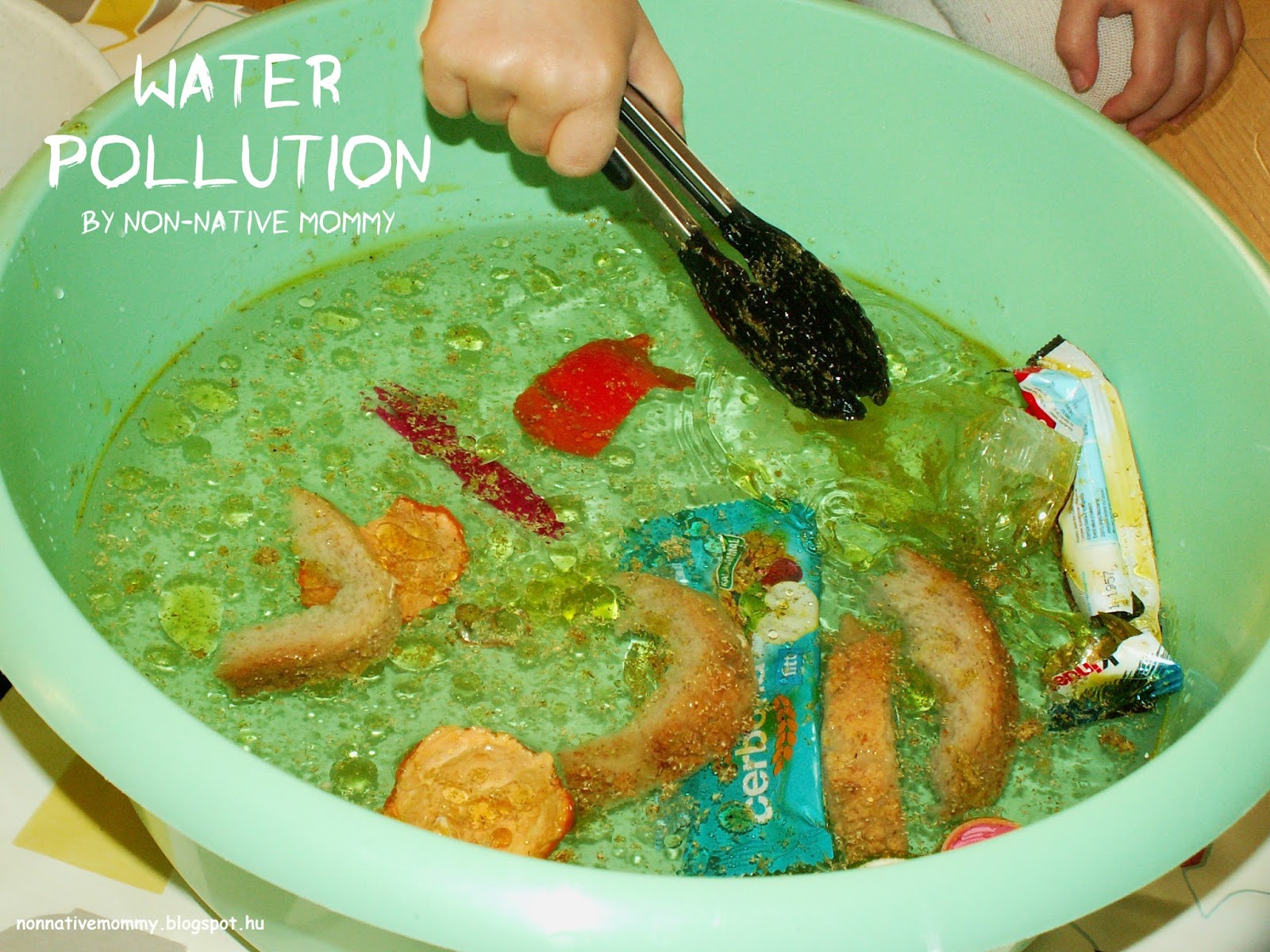
I wanted to create a sensory bin for E. connected to Earth Day. What makes this difficult is she doesn't like to dirty her hands, so we tried the water pollution idea I saw at Every Star Is Different, as she could use some tools to work with rubbish.
What you need:
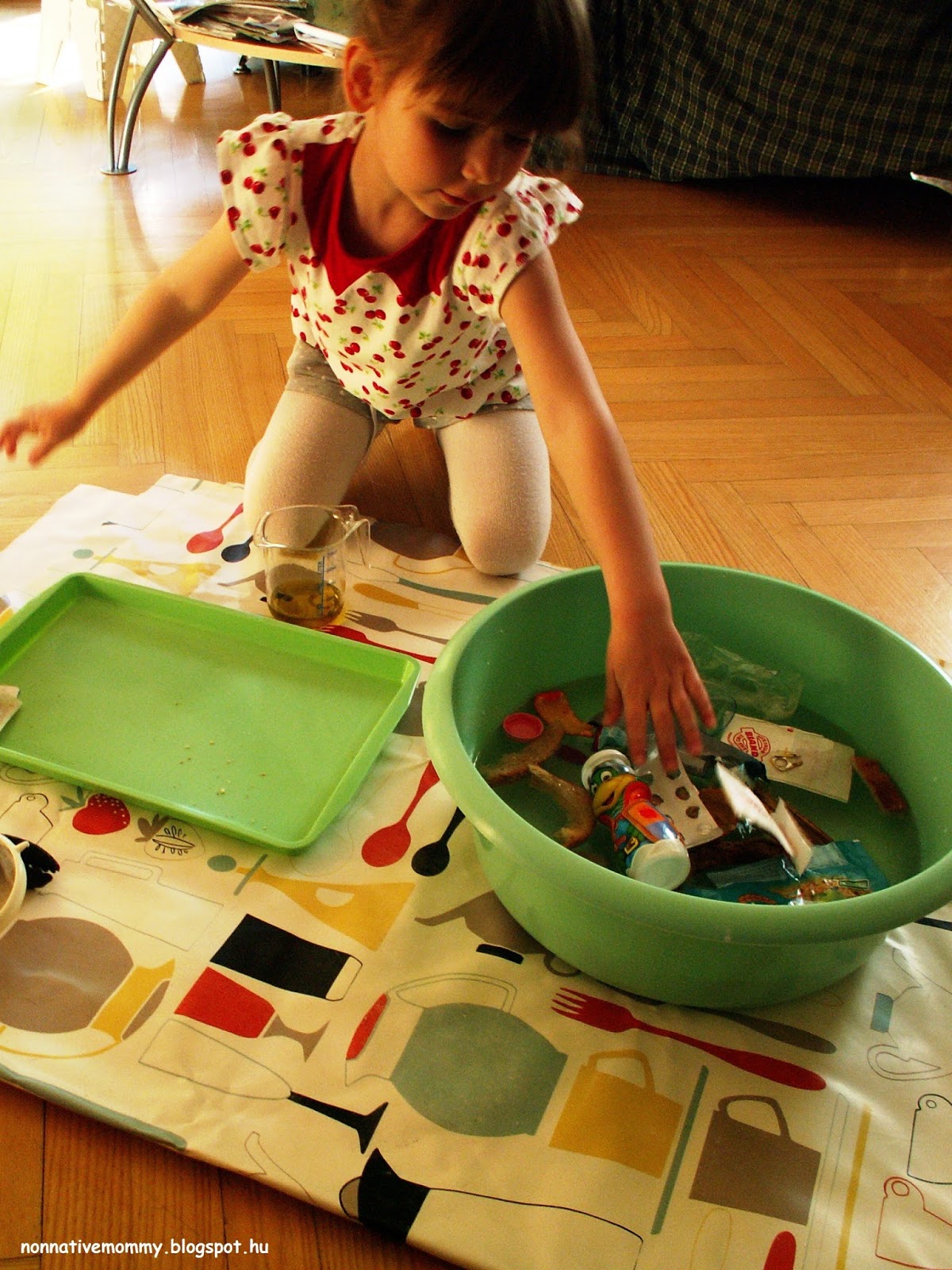
- clean water in a tub of any kind
- rubbish (banana skin, orange skin, crust of bread, tea bag, plastic packaging of any kind etc.)
- oil (optional - it makes cleaning up difficult)
- tongs
- strainer
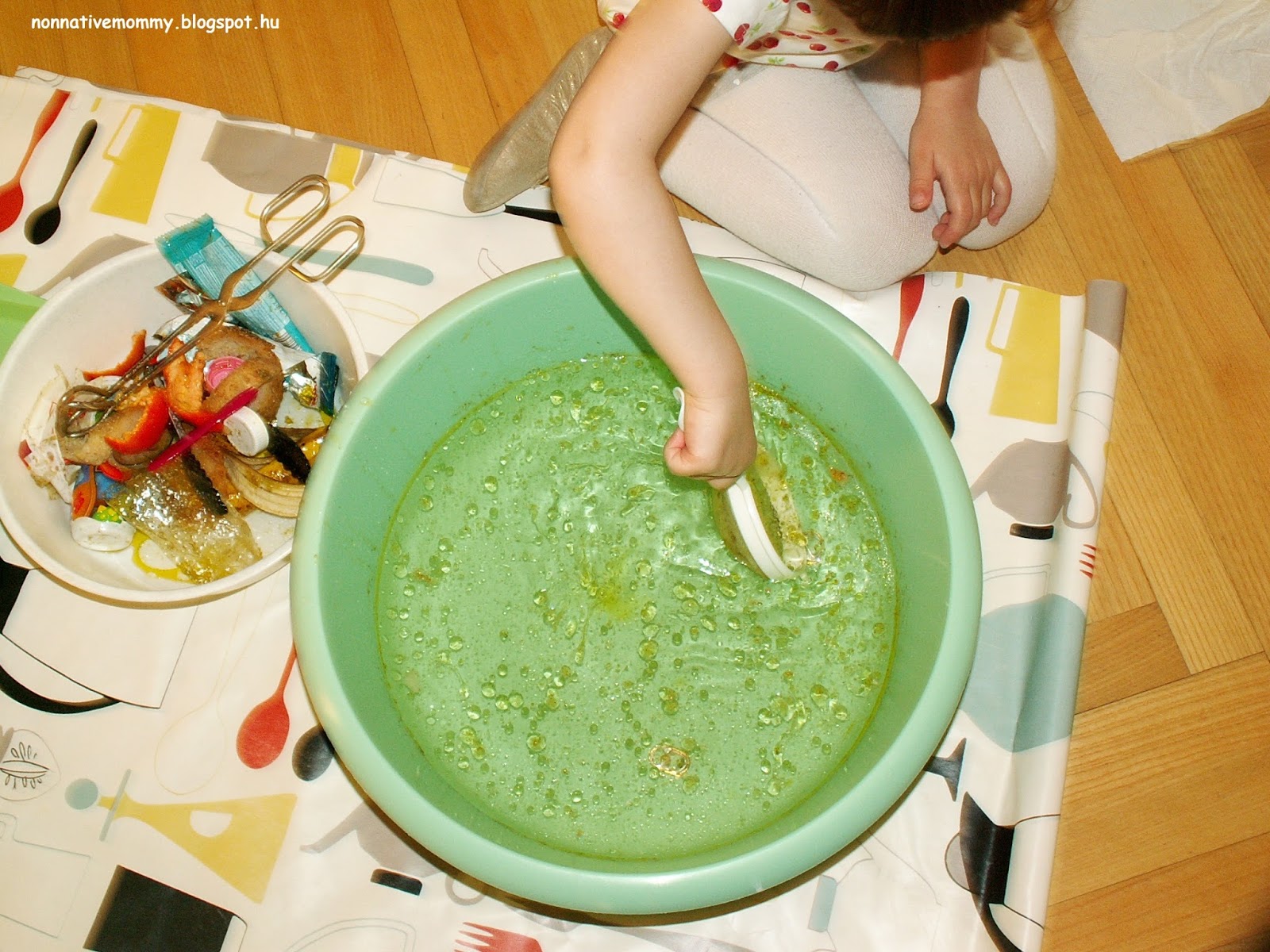
- a bowl to put the rubbish in
What to do:
We talked about the clean water and name every piece of rubbish. We also mentioned natural waters (seas, oceans, rivers and lakes) and that animals live in there.
Then I asked E. to throw all the rubbish in the water. She was quite reluctant at first.
- Why Mommy? It will be dirty.
That was the point. I told her about the scarce drinking water on Earth and also about poor animals which try to survive in the dirty waters.
She also poured the oil in, which was a brave move from my part as everything got oily. The cleaning up lasted forever.
Then she fished out the rubbish from the dirty water.
She tried to clean the oil and the small tea leaves too with a strainer but she didn't managed, of course.
We drew the conclusion: We need to take care of water and keep it clean because we can't drink it or animals can't live in it if it's dirty. And water is essential for life.
Although we had a week having fun with all kinds of apple games and activities (including the study of an apple) we couldn't avoid being ill again. Anyway, here is a collection of apple fun we've done lately.
I've found a great number of apple activities online but I fell in love with the free printables by 3dinosaurs' Apple Pack. This set contains 60 (!) pages of apple activities up to the age of 8-9. Wow! What a great collection! I've just selected a few games that would suit my 3-year old. Thank you, 3dinosaurs for this excellent Apple Pack.
Here is an insight what you could find in the pack:
What comes next? Patterning activity. I brushed it a up a little with Velcro
"The spotty apple is coming now"
Which one is different? Your child needs to find and circle (or put a manipulative on) the odd one out in the row
Pre-writing practice. We tried the easier sheet (laminated so we can reuse them).
Easy-peasy lemon squeezy
But the harder one seemed a little bit too challenging
Picture puzzles with numbers from 1-10 (We were talking about what she could see in the picture: -How many apples can you see? etc.) well, she's always been into numbers, even when she was little (click on the links for earlier posts)
And skip counting by 10s
Shape tracing and matching - a little bit of revision as we've already dealt with shapes a lot
After she's placed all the shapes we practised the "there is..." structure. It didn't appear to be a problem:
Mommy: - There is a red apple in the circle. And in the next?
E.: - In the square there's a green apple. In the triangle there is a yellow one. In the rectangle there's a checked apple and in the oval a spotty apple... or... what's the other name, Mommy?
Mommy: - Do you remember?
E.: - No. You say it.
Mommy: - Polka dotted.
E.: - Haha, it's funny. M., did you know polka dotted? (she turned to her favourite toy, the doggy you can see next to her on the table in the picture above)
Shape revision - tick.
Grouping. Apples and non-apples
She's clearly enjoying it)
Roll and count apples. I guess she enjoyed this one the most. I couldn't find red manipulatives, so we had "green apples" instead of red ones. The Apple Pack has a die cut-out, but I used only the apples and after having laminated them I stuck them on the six sides of a big die I'd found ages before in a OneEuro shop. First, she guessed which apple will win (which apple will reach the top of the chart). Her guess was the spotty. Mine was the yellow and M., E.'s doggy's guess was the stripy apple. Then we rolled the die. Everybody had a turn. Even the doggy :)
M., it's your turn to throw the die.
Of course, M. won.
Apple memory game
This game involved a lot of fun and useful tasks: matching, memorizing, counting. And at the end E. tested her toy dog whether he can name what's on the cards :)
E.: - What is it, M.?
Mommy (in M.'s voice): - Er... I think it's a tree.
E.: - Good job, M.
-And this? Do you know?
Mommy (in M.'s voice): - I know, I know. It's an apple pie. (and so on)
This was real cute.
We've played these games several times as she's asked for them both in English and in Hungarian.
We also studied a real apple to see what parts it has. For this I printed the apple parts booklet by A Little Pinch of Perfect and I highlighted the parts on each card. I didn't put them together like a book, we just had a look at the cards and also the real apple.
She examined all the parts and match them with the cards.
We practised earlier vocabulary like cut it in half, slice it, peel it, sharp knife etc.
She was fascinated by the word "flesh" so she was more than happy to consume it :) I hope the weather and our health will let us go for an apple-picking adventure.
As a part of our flower project in the spring we also dealt with a little science. More precisely, how flowers absorb water through their stems reaching the petals. This colour changing carnation experiment gave me the idea, but there was some glitch in the matrix and we needed to do it twice. Still, the result was far from perfect and I can only hope E. got the point. Let's see.
The flower experiment idea is great, however, we did something wrong or were just unlucky this time.
First of all, what you need to the project:
4-5 white flowers of any kind (chrysanthemum didn't work very well, carnations were better)
food colouring (4-5 colours, or you can mix them)
transparent glasses or viols
water
measuring cup
spoon
towel for spills
scissors
How to do it:
prepare everything on a tray for you child and she/he can do all the activities
add water to the glasses/viols
add the food colouring and mix them with a spoon
cut the stem of the flowers (10-15 cms long)
make the flowers stand in the glasses/vases
wait... minimum 1 or 2 days
In case of the carnations the colouring of the petals could have be seen the next day,
but in the first trial the chrysanthemum took 3 and a half days to show any signs of pigmentation.
While E was preparing (pouring water, cutting stems, mixing colours) the experiment I asked her what she thinks will happen. She didn't have a clue.
- I don't know Mommy, You say.
Then I explained what the coloured water will do:
- The stem will suck up the water, like you suck it up through a straw. (Then she imitated sucking :) )
- The coloured water will be absorbed. (she was digesting the new word) - The water will reach the petals and they will turn red (I pointed at the flower standing in red water), green (I pointed at the flower standing in green water), blue (I pointed at the flower standing in blue water) and yellow (I pointed at the flower standing in yellow water).
In the first round after a week the chrysanthemums started to wilt so we could not observe any more colours on the petals.
In the second round of the experiment, while I was cleaning, I put the carnations on the floor light-mindedly.Then E. accidentally kicked them over. So after 5 days our second flower experiment was over. Anyways, we could see the pigmentation of the petals somehow.
She enjoyed preparing the experiment more than the result. Who could blame her after all...
Let me know if you try this experiment and have better results, let's say, after 10-12 days.
During winter time we had some ice fun I didn't write about as it wasn't really planned. But now, inspired by Yuliya, the writer of Welcome to Mummyhood, I decided to go for it again.
We've altered the task she introduce on her blog to suit our Hungarian National holiday and I used red, white and green IKEA beads instead of sequins.
E. filled up the ice cube tray with the beads.
Then she poured the water (the beads are so light that they were floating on the top.)
After that we put the tray into the freezer. We checked it on the same day whether it was frozen or not, but we had no luck.
We did this preparation in Hungarian and talked about the colours of the Hungarian flag and how water turns into ice under 0 Celsius degree. She listened closely and asked questions about what liquid is and what frozen means. I gave her a basic explanation.
The next day we took it out of the freezer and I set up this tray for E. We were in English this time.
She was amazed as soon as she saw the tray.
First, she was a little hesitant what to do. But then she got the hang of it.
She used all the tool (tongs, fork, spoon and ladle) I prepared for her. Picking, spooning, ladling. First, she was touching the ice cubes with her hands. Abruptly, she said: - It's cold and wet. I don't want to be wet.
And she picked up her favourite tool, the tongs.
And she was bewildered by the chemical reaction.
She was playing with it for 40-45 minutes. Mostly alone or with very little assistance.
Once she tasted the baking soda. Nothing happened, of course, and when I asked her if it tasted nice, her answer was positive. Luckily, she didn't try it again.
Before her nap time, she was asking about the ice experiment (vinegar and experiment are words that gave her a hard time to pronounce. Once she said ligament instead of vinegar... haha. So cute!)
All in all, it was a wonderful experiment, loads of fun and a lot of new vocabulary learnt in both languages. We'll definitely do something similar again. I was thinking of volcanoes...
Here are some vocabulary/phrases connected to our experiment:






.jpg)
.jpg)
.jpg)
.jpg)
.jpg)
.jpg)
.jpg)
_.jpg)
.jpg)
.jpg)
.jpg)
.jpg)
.jpg)
