Showing posts with label flowers. Show all posts

Thursday, 19 May 2016

A bit of Earth Day gardening

Before our American native nanny left Hungary we had a flower planting last session with her. Although I wanted to do this activity on Earth Day, the weather did not favour us so we had to postpone it for a few weeks.


I bought the plants at a flower market that is close to our place: 6 flowers and  a green plant:


Verbena
Snapdragon
Marigold
Periwinkle
Petunia
Dakota Sunspot
White-edged Swedish Ivy (a kind of mosquito repellent with leaves that has special smell if you rub it, no flower though)


You can download the flower picture here. (Buttercup is also included as E. found one in a field and we needed to check what it was). The names are added both in Hungarian and in English.


What you need:

  • flowers/plants of your choice
  • flower pots
  • soil (we had 5 kg for 7 plants)
  • shovels
  • watering can with water

How we did it:

Best to do it in the garden or on the balcony but the weather was very windy (still is) so I put down an old wax tablecloth on the floor and we did the planting on it indoors. In this way we did not dirt the whole living-room and it was relatively easier to clean up.

E. doesn't really like to dirt her hands. I try to come up with ideas when she needs to do so in a fun way so she can overcome this bad feeling of dirty hands.

She touched the soil/dirt with great hesitation, though.

We filled up half of a pot with dirt.


She took the plants out of its small pot and pinched off some ends of its roots (it was L.'s advice that she'd learnt from her mom)


Then, she placed the plant into the bigger pot in the new soil after having created a little hole in the middle and added more dirt on top of the roots.


We have some nice blue buckets which can be hung on our balcony so the final step was that E. put the pot in the bucket.


When we were ready with all the plants she took them all out onto the balcony and hung them up.


Let's not forget about watering the plants.


For a few days she wanted to go out and water them, but now it's been a week she last saw her plants. I need to water them, but it's true that a lot has been going on recently because of her birthday. Not to mention the fact that this strong wind we've had nowadays has destroyed the flowers and to be honest they are far from nice at the very moment. I can only hope a little later they'll revive when the weather gets better and E. will show some more interest in them.

All in all, it was great fun, a nice way to have one of our last sessions with our nanny, L. I admit it was quite messy, but E. enjoyed it and learnt a lot about planting, getting your hands dirty, decorating our home and taking care of a living creature.

Her English vocabulary expanded: she learnt quite many synonyms like shoots/sprouts, spade/shovel, throw away/dump, soil/dirt. (For the Hungarian readers: when she told Daddy about our planting project she said: ." ...aztán koszt raktunk a cserépbe")

What gardening project do you do with your kids in the spring? I'm looking forward to your answers in the comment section so we can do something new next year.

Sunday, 8 May 2016

Peony petals suncatcher

I've seen tons of suncatcher ideas on pinterest and I've always wanted to try it with E. As the bunch of peonies I'd got from my mum for Mother's Day started to lose their petals, the right time came to make our first sun catcher.


As it was a sudden idea when E. started to play (collect and cut) the fallen petals I didn't have time for too much preparation.


I took out our sticky paper (originally it's self-adhesive school book cover) and drew a flower on it (the transparent backside) with a permanent marker. (You can cut a flower shape outline out of paper and stick on the sticky side but I needed to be on the double). I pulled off the white part and fixed it on the table (with cello tape). I also presented some leftover yarn and green leaves on a tray apart from the petals.


E. did the sticking.


I wanted to talk about the different parts of the flowers but she wasn't interested. Maybe at another time. She was too busy with the sticking.

Then when she told me she'd finished I put another sticky sheet over it (sticky side facing

down) and cut along the flower outline.

The last thing E. needed to do was to stick the suncatcher on the window (with some Cello-tape, but you can also hang it)


I'm sure we'll do some more suncatcher crafts.

Thursday, 17 March 2016

Snowdrop craft with our new native nanny

Spring has arrived and brought us a new nanny, L. from California. Unfortunately, how long she'll stay is uncertain, but even a few months will do. Here is a fun craft activity they did together.

I found this snowdrop idea on pinterest:

http://krokotak.com/2015/02/three-ideas-with-eye-make-up-remover-pads/

While E. was in the nursery I prepared the following:

The quality of the pictures are so poor... sorry.

  • 15-16 cotton pads cut-outs
  • blue construction paper
  • green construction paper (the leaf cut-outs)
  • glue
  • green markers
L, our new nanny came at 5 and they immediately sat down to make the snowdrops excitedly. I made an example for them to follow to make the whole process easier.

 They started with drawing the stems and gluing the leaves.


They also coloured the snowdrops' top green:


 Some cutting and glueing:


"I need more snowdrops"


Adding some more snowdrops:


We displayed them on the living room door:


Of course, this wasn't their first occasion to meet but the 3rd or 4th. However, E. and L. hit it off at the very beginning. E. needed time to realise L. doesn't understand when she mixes some Hungarian in her talks. I'm glad to say E. uses less and less Hungarian when she speaks English, and not only when our new nanny is around. Thanks, L! We've really needed the native input.

If you liked this flower craft have a look at other flower projects we've had:

Flower flashcards
Colour changing flower experiment
Flowers made out of crepe paper and bottle tops

5 + 1 tips to sneak in some English time

With a newborn in the house it's extremely difficult to spend time in English with E. It's challenging to spend time with her at all when L. needs me 7/11.

Here is a few tricks we sneak some English time in our weekdays:

1. E. goes to the nursery and comes home in the afternoon. Whenever she enters the door I greet her in English. Sometimes she doesn't want to speak English at all, at other times I tell her that Mommy has been in English with L. all day then she is more likely to give in and we spend the evening (playtime, video time, dinner, bath and bed/story time) or part of it in English.

Bedtime reading - Picture Atlas

2. I rely on her new interests., i.e. at the very moment wind types and the Beaufort scales. She got a book for Christmas from her Godparents (in Hungarian):


She loves the Beaufort scale in the book, so with Daddy's help we made our English version of it.

3. New nanny: Although our new nanny is only temporary (for max. 2 months as she's returning to the US) her visits have increased our English playtime.

Making snowdrops with or new native nanny, L.


4. Holidays: preparing for a birthday or St. Patrick's day for instance has also given us a chance to practice our in English

Heart garland for Valentine's Day

5. Helping around Baby Sister: E. helps a lot with bathing, dressing or entertaining Baby Sister. Every now and again I manage to convince her to use English in these situations.

Helping Baby Sis get undressed

+1 Cooking/baking together is always a hit with E. She is always happy to help me in the kitchen and it goes without saying we do things there in English most of the time.
String the mixture
Life seems bright again :)

Monday, 24 August 2015

Flower experiment

As a part of our flower project in the spring we also dealt with a little science. More precisely, how flowers absorb water through their stems reaching the petals. This colour changing carnation experiment gave me the idea, but there was some glitch in the matrix and we needed to do it twice. Still, the result was far from perfect and I can only hope E. got the point. Let's see.


The flower experiment idea is great, however, we did something wrong or were just unlucky this time.

First of all, what you need to the project:

  • 4-5 white flowers of any kind (chrysanthemum didn't work very well, carnations were better)
  • food colouring (4-5 colours, or you can mix them)
  • transparent glasses or viols
  • water
  • measuring cup
  • spoon
  • towel for spills
  • scissors

How to do it:


  • prepare everything on a tray for you child and she/he can do all the activities
  • add water to the glasses/viols

  • add the food colouring and mix them with a spoon


  • cut the stem of the flowers (10-15 cms long)

  • make the flowers stand in the glasses/vases


  • wait... minimum 1 or 2 days
In case of the carnations the colouring of the petals could have be seen the next day,


but in the first trial the chrysanthemum took 3 and a half days to show any signs of pigmentation.


While E was preparing (pouring water, cutting stems, mixing colours) the experiment I asked her what she thinks will happen. She didn't have a clue.

- I don't know Mommy, You say.

Then I explained what the coloured water will do:

- The stem will suck up the water, like you suck it up through a straw. (Then she imitated sucking :) )
- The coloured water will be absorbed. (she was digesting the new word)
- The water will reach the petals and they will turn red (I pointed at the flower standing in red water), green (I pointed at the flower standing in green water), blue (I pointed at the flower standing in blue water) and yellow (I pointed at the flower standing in yellow water).

In the first round after a week the chrysanthemums started to wilt so we could not observe any more colours on the petals.

In the second round of the experiment, while I was cleaning, I put the carnations on the floor light-mindedly.Then E. accidentally kicked them over. So after 5 days our second flower experiment was over.  Anyways, we could see the pigmentation of the petals somehow.

She enjoyed preparing the experiment more than the result. Who could blame her after all...

Let me know if you try this experiment and have better results, let's say, after 10-12 days.

Tuesday, 4 August 2015

Flower crafts

This post should have appeared in May the latest when we finished our flower projects. Well, there are tons of flowers around us during the summer time so it's never too late to have a closer look at them.


Now I'd like to share  2 of our flower activities with you (later, in another post I'll write about some science experiment involving flowers)

1. Bottle cap flowers 

I've been collecting bottle tops for a long time and I've only had one or two good ways to use them, like the bottle cap calculator or the colour matching and size sorting activities.

What you need:

  • bottle caps of different colours
  • green straws
  • glue
  • cardboard
  • scissors (optional - not in the picture)

How to make it:

Show and explain your child the different (basic) parts of a flower. E. had already known these parts so E. named them as I put together a flower.

we didn't go under the ground so no roots


Then we both started to work on our flowers. We were talking about what colour petals we chose or if our stem was long or short, if the flower had leaves or not.


E. used the scissors herself to cut the stems.


E.'s pic
Although not in our pictures, we also mentioned that a seed (Can you see in E.' picture the tiny seed on the ground on the left side? It was totally her idea) should go to the ground and with the help of water and sunshine it grows into a flower (hence the watering can on E.'s picture and the sun in mine)


Mommy's pic


This is just the first step on parts of a flower. We'll expand the topic later on. I'm planning to prepare some flashcards and worksheets on more detailed explanation on flower parts.

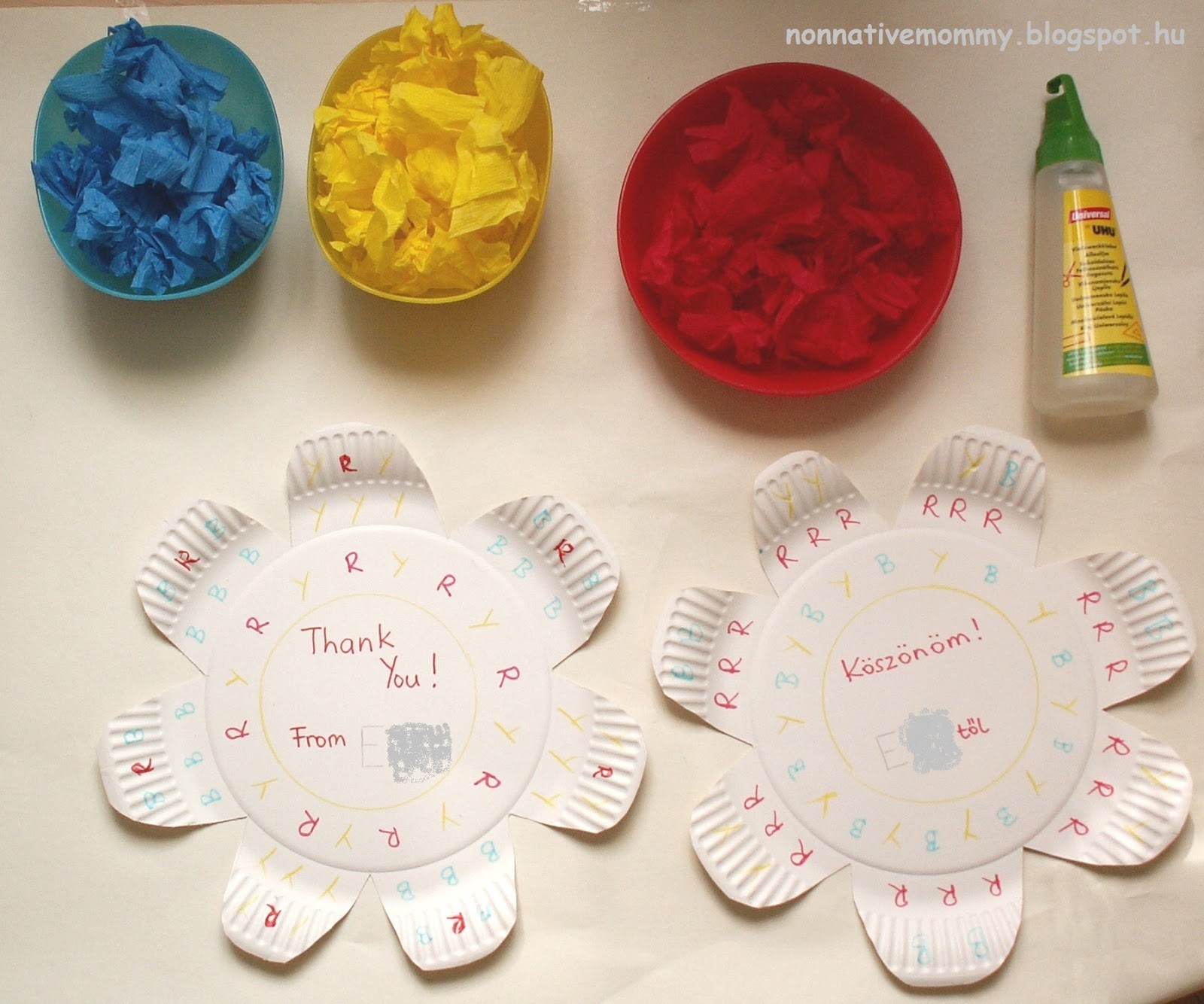
2. Paper plate flower - a goodbye present

E. has said goodbye to her créche teachers and started kindergarten in July. We prepared these paper plate flowers as part of her goodbye presents. (You can find the original idea through the link)


What you need:


  • paper plates (we used 3 for 3 flowers)
  • crepe paper of different colours
  • Popsicle sticks 
  • green paint
  • glue 
  • cello-tape (optional)
  • markers

How to make it:

Cut out flower petal shapes of the plates. First, I drew the lines on the paper plate then I started cutting.

As I know E. has no patience to do long tasks I decided to direct her attention on coloured letters written on the paper plate. The letters showed her where to stick which colour. Her focus was much better in this way.

I also wrote Thank you! in the middle and letters of her name she could trace.

I cut up the colourful crepe paper into small pieces beforehand. We ran out of them on the way so she wanted to cut more crepe paper herself. 


Cutting practice

This was a great way to relax a little bit as there's lengthy gluing involved.

Pinching the crepe pieces


just a dab of glue


A goodbye flower for Bea néni

Finally, we painted the popsicle sticks and glued them on the back of the flowers. (I fixed them with cello-tape just to be on the safe side.)

We did this projects in two goes as it was tiring and long-winding.
E. was still enthusiastic, even at the second round.

Unfortunately, I forgot to take a photo of all the three flowers so here is what we made for Ms K.


Needless to say, they were all over the moon when they received their presents.
Have you done some flower crafts or projects lately? Do not hesitate to share it in the comments below.


To be continued.... with a flower science experiment. Stay tuned!


Related Posts Plugin for WordPress, Blogger...