Showing posts with label sensory. Show all posts

Thursday, 1 September 2016

Baby sensory bottles

When Baby Sis turned 6 months, E. and I prepared these sensory bottles for her.
The idea was taken from pinterest, where you can find tons of variations. I tried to keep it as simple as possible.


I picked 5 Jana water bottles for babies. I peeled off the plastic cover. E. and I filled them up with all kind of things we found around the house:

  • heart-shaped pasta
  • rice flakes
  • millet balls
  • cut-up plastic straws and decor stones
  • water beads

Then added water to the one with the straws and the water beads. Simple as that. I know she can't open the bottles tops just now but sooner or later she'll be able to so I glued the tops on.

You can fill them up with glitter, hair gel, pom-poms, beans, lentils, buttons, tiny plastic toys, jelly beans, M&Ms, corn, popcorn, beads, elastic bands, jingle bells, sand or you name it.

If you add oil or glycerine to the water the light objects will float slowly.

Baby sensory bottles

When Baby Sis turned 6 months, E. and I prepared these sensory bottles for her.
The idea was taken from pinterest, where you can find tons of variations. I tried to keep it as simple as possible.


I picked 5 Jana water bottles for babies. I peeled off the plastic cover. We filled them up with all kind of things we found around the house:

  • heart-shaped pasta
  • rice flakes
  • millet balls
  • cut-up plastic straws and decor stones
  • water beads

Then added water to the straws and the water beads. Simple as that. I know she can't open the bottles tops just now but sooner or later she'll be able to so I glued the tops on.

You can fill them up with glitter, hair gel, pom-poms, beans, lentils, buttons, tiny plastic toys, jelly beans, M&Ms, corn, popcorn, beads, elastic bands, jingle bells, sand or you name it.

If you add oil or glycerine to the water the light objects will float slowly.

Saturday, 13 February 2016

Valentine's Day sensory bin

Last year we didn't really celebrate Valentine's Day but used the opportunity to do a lot of fun crafts and activities with the symbols of Valentine's day, like hearts, candies, chocolates etc.


 This year I've come up with a sensory bin idea for this occasion.


What I used:
  • one big container (IKEA)
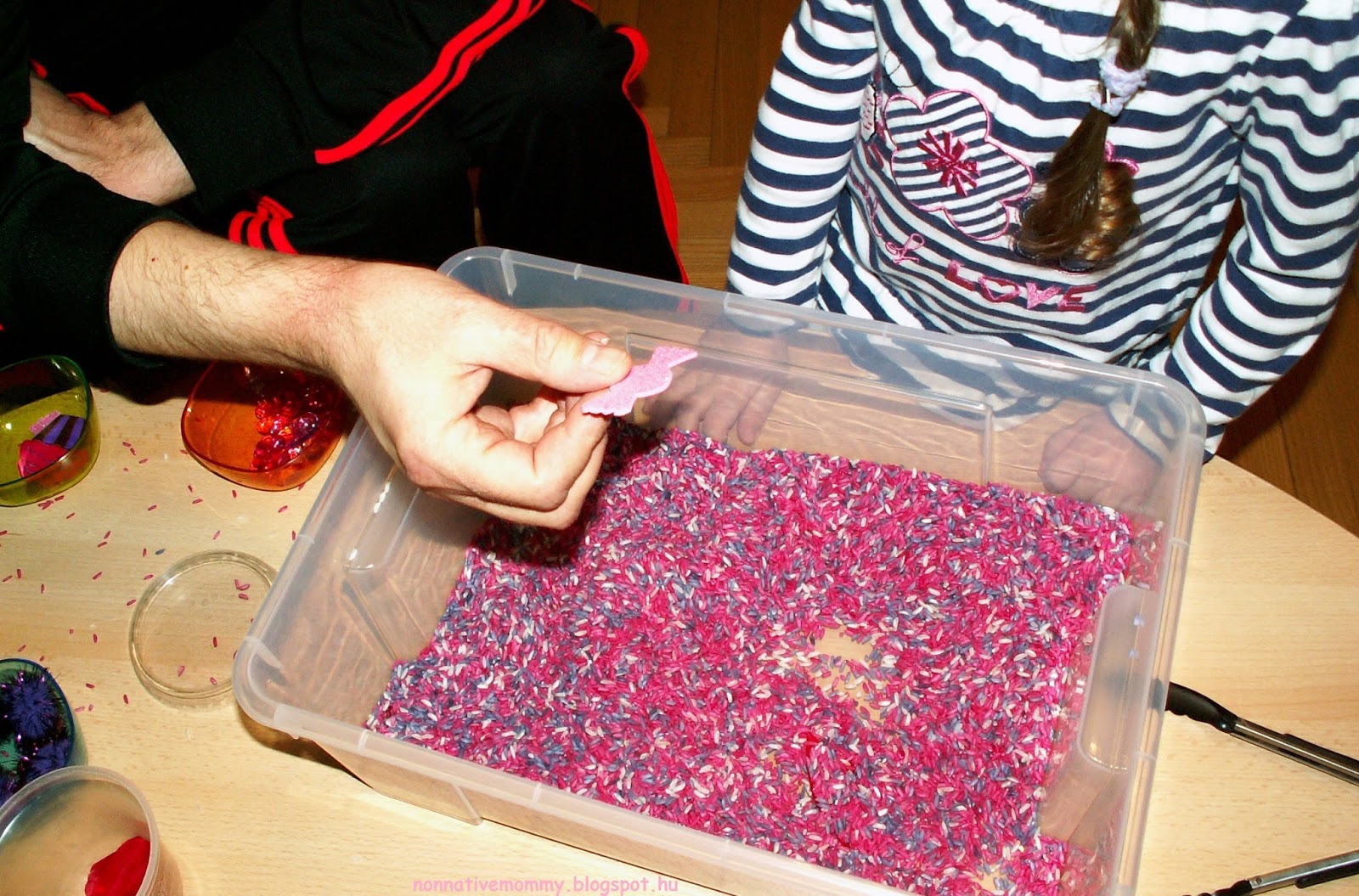
  • coloured rice - red, purple, and white (see how to make it below)
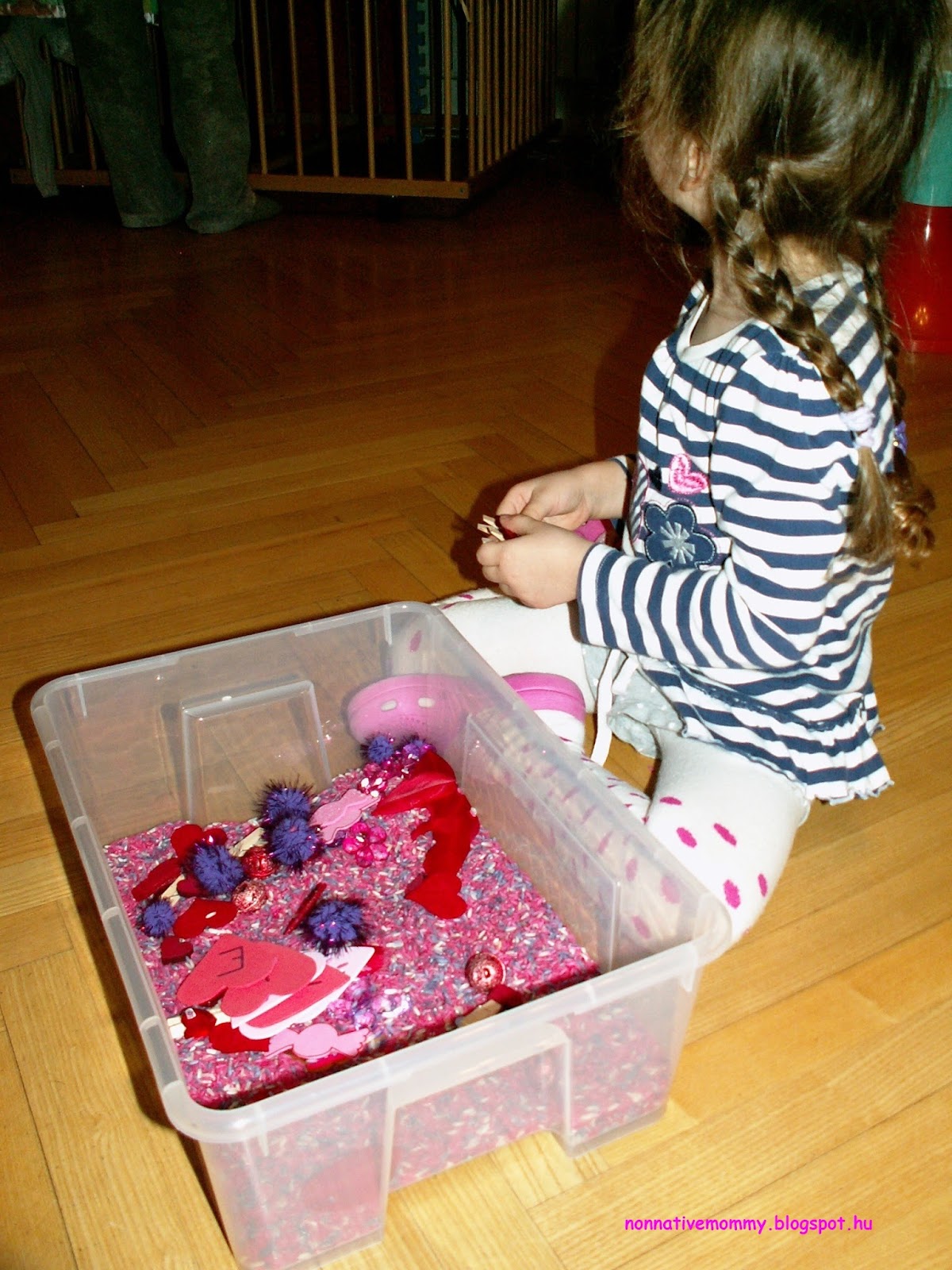
  • hearts, candies, feather, beads (whatever you have) to search for in the bin hidden in the rice
  • cups and bowls
  • tools like ladle, tongs, tweezers (I couldn't find the tweezers :( )

How I coloured the rice:
You need:
  • a zip lock bag (IKEA)
  • 2 cups of rice (any kind of white rice will do)
  • food colouring (liquid type is better than the gel)
  • a bit of alcohol (optional)
How to do it:

Put 2 cups of rice in the zip lock bag, add 1 teaspoonful of red (or any other colour) food colouring and half a teaspoonful of alcohol. The latter is optional. It helps to get brighter colours plus your rice will last long if not forever...

Now give it a shake until the colour is everywhere on the rice. (I didn't but you can do it with your child. It must be fun for them to see how the rice changes colour)

I did the same with the purple rice. As I didn't have purple food colouring I mixed it out of red and blue beforehand.

I dried the rice on baking paper to make sure it won't stain my hand and to get rid of the smell of alcohol.

I put the rice in the container (half red, half purple - my daughter did the mixing) and I also provided some white rice for extra fun.


What I put in the bin:
  1.  wooden muffin
  2. purple butterfly beads
  3. sparkly candies (cut out of a foam sheet but you can add real candy, too)
  4. red jingle bells
  5. wooden hearts
  6. pegs with hearts on
  7. purple pompoms
  8. pink flower-shaped beads
  9.  red feathers
  10. felt hearts
I hid them in the rice as much as I could.

Extras: I cut out 6 hearts and wrote the letters of my daughter's name on them. I also put them in the bin so she can make her name when she finds them. (The easiest way to make the foam hearts is to use a heart-shaped cookie cutter. I pressed it on the foam sheet and cut along the print it made.)

E. was pretty excited about the bin as soon as she saw it.


She poured in the extra white rice.


She happily used the ladle and the tongs.


She used the bowls to put in whatever she found. (It was interesting to see that she separated them like hearts, round things like pompoms, bells, and beads all by herself)


She also enjoyed mixing the coloured rice with her hands.


After she'd found and taken out everything she asked Daddy to find what she'd hidden. Then they took turns and did the same again and again.


The next day I gave her 2 sheets with the objects she can find in the bin on the top and she selected them in each column. We did a little counting as well.


On the second day I also added the letter of "I LOVE YOU"
With a little help she could put it together.


She's been playing with it ever since.
-Mommy, we can play with it on the floor, too - she said and continued down there.


TWO other activities to do with the rice:

  1. write with fingers
  2. I spy bottle

    What are these? Come back later to check them out and I'll show you in another post.


Sunday, 2 August 2015

Blood sensory bin

E.'s new focus is on the human body, more precisely on BLOOD. She loves talking about it, seeing it, reading about it and experiencing it. That's why the sensory bin idea has come up.


She started to be interested in blood when she first saw some blood vessels in the Usborne book titled: What makes you ill?


This book is about a lot of other things and not only blood: symptoms, germ types, allergies, cuts, lumps and bruises as well as a healthy lifestyle.

She's been asking so many questions about our blood: Why is blood red? When does it come out of our body? What do white blood cells do? What are germs?

I remembered seeing a great activity on blood and after having searched for it for days I didn't manage to find so I had to do with what I remembered.


What you need:

  1.  a big bin (IKEA)
  2. water (about 1 litre)
  3. water beads (red and white - you can buy them at the florist's or order them online)
  4. plastic straws (of 3 different colours. I used purple, black and yellow)
  5. red foam sheet

What to do:

  1. Put the red and white water beads in two bowls and add half a litre of water each. Let them soak for 5-6 hours or overnight


  2. Cut up the straws into different shapes


    Antibodies (yellow straw pieces) help to kill germs (viruses and bacteria). They are the memory of the immune system.

    Viruses and bacteria (purple and black straw pieces) are tiny germs attacking your body and making you ill.
  3. Cut out rectangle shaped platelets (at first I forgot to make these, nevertheless, E. has been playing with this sensory bin for more than a week now so I had time to add them)


  4. Prepare the beads, the straws and foam rectangles, some measuring spoons or ladles, a let your child explore it.
    spooning the red blood cells
    Red blood cells (red water beads) carry food and oxygen to the cells in our body.

    Adding the antibodies
    Spooning the white ones


    White blood cells (white water beads) fight off germs (viruses, bacteria).

    Plasma (water) makes it possible for the blood to move around our body.

    Of course, before she started I explained what is what. While she was pouring in the "ingredients" I was commenting what she was adding what their functions are in the blood.
  5. Optional: Add some more bowls for more spooning


It was never ending fun and still is. The beads lasts for weeks if you don't forget to add some more water every now and them.

Few days ago I found the site where I first saw this idea:  I can teach my child - What is blood made of? They use ping-pong balls for white blood cells... What a great idea!

Sooooo nice to touch the beads

Look, Mommy! A virus!

Antibodies are stuck on the bacteria and burst them
Throughout the week I added some other tools to fish out the germs: tongs and tweezers:


Platelets (red foam rectangles) help to block a hole in your blood vessels when you have a cut. They do not let your blood out of your body.


E. has been playing so much with the blood sensory bin that we've had enough time to cover the blood-related vocabulary both in English and Hungarian. So here is a word list to help you if you decide to prepare this fun activity for your kid. If I'm in a good mood, I might make some flashcards in this field.


Related Posts Plugin for WordPress, Blogger...