Showing posts with label flash cards. Show all posts

Tuesday, 14 April 2015

FAQ

In the last couple of weeks I have bumped into a lot of mums who asked me similar questions about raising our daughter bilingual in a totally monolingual environment. So I collected a bunch of questions and my answers to them with some links from earlier blog posts:

  1. Do you speak to her English only?

    No, I don't. I can't do that. My mother tongue is my mother tongue, no matter how high my level of English is. (High level of language command is relative. I always feel my English is deteriorating.)

    I assigned certain times to speak English. When E. was a baby we had a timetable which meant that we used a little bit more English than Hungarian as she spent loads of time with me. Then we needed to change our schedule, still we had 50-50 % balanced language usage. (When she was around 2). Nowadays, (she's almost 3) we are in trouble with the balance between the two languages as we do not spend so much time together therefore there is less English in her life. BUT! Her English basis is so strong that she asks for changing languages when she feels she misses one of them (it's usually English)

    Even today, whenever there are just the two of us she says: - Uh-uh, Mommy. We need to change into English. We are just two.
    or
    - I've already changed into English, because there is only Mommy and I.

  2. When do you speak English to her and when Hungarian?

    There are many methods you can follow. What I use is a special one: I call it the timetable method. By now we don't have a timetable any more. Whenever we can, we speak English, as the Hungarian input of the environment is too influencing.

  3. When did you start talking to her in English?

    When we took her home from the hospital. At first, I was just singing songs and chanting rhymes to her in English. I wasn't sure about what I was doing and it felt strange. Then I got some inspirations after having read some books and contacted some other moms in the same shoes. From the age of 6 months I've been talking to her in English just like in Hungarian.
     
  4. Wasn't she late with speech development?

    Not at all, although it would have been perfectly normal. She was about 1 year old when she could say 6-8 English words (and Hungarian ones too). Actually, her first word (bib) was in English. Of course, these words were fuzzy and not distinct for the untrained ears. But by the time she turned 18 months these words had become clear and a LOT more had been added to them. Not to mention, she started to build up 2-3 word sentences at that time too.

    I have to admit that the period between the age of 12 and 18 months was filled with more English sessions that Hungarian.

  5. Doesn't she mix the languages?

    She does! At first she didn't, however, nowadays more and more. I'm not worried about it... okay... I am a little bit concerned, but I know if we keep up the balance between the languages she'll have all the language tools in both languages to express herself. Most of the time she mixes Hungarian into her English because she doesn't know a word or she can't express something due to lacking a structure.

    Though it happens the other way round, too. She makes her grandparents puzzled when she asks for some stories with the telescope in it (mind you, pronounced it with a perfect British accent) or when she says she wants to play on the see-saw at the playground. Sometimes she names some bugs (bumble bees, wasps, ants) or plants (pansies, daffodils, shepherd's purse etc) she sees in the park in English. They can sort out this teeny-weeny language problem... for the time being.

  6. What do you do when she mixes the languages?

    I keep on talking in the given language. I don't change. And I do NOT advise you to let your child take the lead (although it is also an option.) I go on talking, let's say, in English when she says some Hungarian words or sentences here and there. If I know she could say it in English I ask back: - What did you say? or - What's that in English?

    If I am aware of the fact that she can't express herself, I simply repeat in English what she said in Hungarian. Some sources suggest not to make your child repeat a word or sentence, yet sometimes I ask her to repeat just to reinforce we use English and help her fix a structure she cannot use (at all, or properly). Nonetheless, I'm not forcing it. Normally, she repeats expressions after me by herself. If she doesn't want to, we move on.

    Also, you can pretend you do not understand what your child says, but in our case (we do not follow the One Parent One Language -OPOL-strategy; she can hear me talk both Hungarian and English) it wouldn't work as my daughter knows that I understand and speak both. The other problem with this could be that your child can get frustrated if he or she can't put an idea or a wish across.

  7. What English activities/programmes can you take part in?

    We used to have a native British nanny for almost 2 years. I'm really grateful for her as she meant that I could have some free time (cooking, washing, ironing, shopping, cleaning etc.) while I knew English was still in focus in my daughter's life. Now we are looking for a new nanny. If you happen to know someone in Budapest who would be interested I would appreciate it.

    I've organised a Mums' English Club (MEC) in the library nearby, where mums gather with their little ones and chat in English while the kids play away. At the end of our sessions we sing some English songs for the kids. An afternoon session of MEC is badly needed but I haven't had time to find a place where we could go free of charge.

    We've been taking part in the well-known Helen Doron School's programme since E. was 10 months old. We are planning to leave it, but I'll write about that in a later post.

    For almost a year we took part in a swimming course which was instructed both in English and Hungarian. We met there some non-Hungarian families who communicated mainly in English, so E. could hear during the swimming sessions that English is not just Mommy's crazy language.

    We also visited Rhyme Time sessions (singing and playing in English) for a few times, but we do not go regularly.

  8. Does Daddy speak English to her?

    He does. Daddy speaks a lot of languages, it's no problem for him at all. What's more, practising English regularly helps him improve his spoken skills as well. I suppose he also enjoys our English session;

    Again, at the beginning we did it differently. When Daddy arrived home from work we changed into Hungarian, but the whole day was in English. Nowadays, as I'm starting to work, E. is spending more time with the grandparents or she is in the nursery (not to mention that our native nanny, A. has left) we have been trying to fit in as many English sessions as we can.

    We have plenty of dinners, weekend programmes, playground visits, craft activities and bath times in English with Daddy. I'm very lucky, because my husband is very supportive concerning our bilingual project.

  9. Can she say sentences?

    Haha. This has been the funniest question so far I've received. Sure she can. :) Sometimes very complicated ones. I was really amazed when she said a passive sentence in the playground (- Look, Mommy, the other swing is taken) or when she talks to her soft toy using present perfect (- What have I told you?). One day she was replaying a Berry and Dolly episode (Gingerbread) that we watch in English.

    The following left her mouth: - I'm making gingerbread with the cookie cutter and then I'll put it out in the winter (sic) to cold (sic). Magpie, (that is me) come and take it away.
    Later in the story: - Don't take away that belongs to somebody else.

    Here is the episode:


    Not only her sentences but her vocabulary is also outstanding. I'm often surprised at how eloquent words she knows. The other day she called a pan saucepan. I don't think I have ever used this word with herOr she can name different kinds of onions: leek, garlic, spring onion as well as varied expressions for the eating process: munch, chew, stuff your face, digest, feed, bite

  10. How do you "teach" her (sic)?
    This is exactly how this question is asked most of the time.

    And the answer is : I do not teach her.

    What I do is to play with her in English just like in Hungarian. We do the daily routines in both languages. I try to prepare everyday and special activities for her which give us a chance to meet a lot of new situations:

    experimenting,
    prepping for holidays of the English speaking world,
    doing fun craft activities,
    - cooking and baking
    - doing housework together
    - exploring nature
    - reading books and singing a lot as well as watching videos

    These are just a few examples. In short, we LIVE our lives in 2 languages.


    +1. How shall WE start?
"The secret of getting ahead is getting started" - Mark Twain

So just start it.

If you want to get some ideas read through the blog... HAHA. Believe me, it'll be much easier to find your own ways. But you can get some ideas here. (Feel free to search for keywords if you're looking for something exact)

Start with some songs that you sing to your child while changing nappies or waking him/her up.

Search some videos online around a topic (cars, shapes, animals, numbers, planets etc.) that your child is interested in and watch them together. You can also explain what you see in the videos.

Learn some rhymes/songs with sign language and play with your munchkin.

Flashcards are almost always fascinating for children, but rather time-consuming to prepare your own home-made ones. On the other hand, our own flashcards are much more attractive to my daughter. You can find really good flashcards online, which you only need to print (and perhaps laminate).
If you don't mind spending some money, you can buy some beautiful ones.

And I haven't mentioned the endless opportunities that books offer to speak and practise a foreign language.

Again, these are some very basic ideas to start with your little one from an early age.

If you have any questions, do not hesitate to contact me either in the comments or via email. You can come an visit my facebook page as well.

Enjoy!

Sunday, 7 December 2014

Getting familiar with the ABC

I do not want to brag, but yes... a little I do. E. is so  interested in the letters and the ABC that, I do not exaggerate if I say, within a year or two she'll be reading. In this blog post I would like to collect some fun activities we've been doing with the ABC.


-Videos/Songs

The very first favourite. E. was watching this video her mouth agape in amazement when she was 8-10 months old. Phonic Song 2 by KidsTV123


The traditional one is always the best (Upper- and lowercase) The ABC Song by KidsTV123


A song about how to pronounce the letters - Phonic Song by KidsTV123:


Since the age of 2 we have been watching a lot of Mother Goose Club songs: (ABC song with Eep the Mouse)


She could watch it all the time. Sometimes she wants to watch them all day (if I let her).


- Magnetic alphabet


I bought the first set of magnetic alphabet when E. was about 18 months old. She loved them at once.
First, it was just one pack of upper case letters. We used it on the fridge, but the letters always fell under it. So I had a magnetic word game at home (for adults, the letters are too tiny for little children) and I started to use one of its steel boards (You can also use a steel tray or a magnetic whiteboard)


Then I bought another pack of both upper- and lower case letters later when we started making up words at about the age of 20-22 months. (Frankly, we don't really use the lower case letters yet - age 2,5 years. Update: at the age of almost 4 we still do not really use the lower case letters)

At the very beginning we just put together the alphabet from A to Z. We sang the ABC song and/or the phonic song while arranging the letters.

Adding the missing letters to the alphabet with Daddy

 I told her words starting with certain letters, like  E. for her name or D for daddy, M for mummy, A. is for our nanny's name etc. As time passed I added some more words, such as E. is for elephant, egg, or A is for apple, ant and so on, not just names. I always tried to include things that she knew or she was really interested at that time. Within a few days she was the one who said the words: - B is for ball and bubble.


Next, we made up short words she was already familiar with.
Daddy, Mummy, M. (our dog), dog, cat, yes, no, hat, rat, egg, bat and so on. I have no intention to teach her how to read. She is the one who, from time to time, comes to me with the letters to play with. She'll work it out by herself.


- Matching game with the magnetic letters

What you need:

  • letters (magnetic, felt, play dough, cut out from cardboard, drawn on bottle tops)
  • plastic surface (e.g.: whiteboard, but I used an A/4 sheet that I spoiled while laminating. 
  • markers (not permanent!!!)
  • sponge or tissues to wipe the surface if you want to reuse it
First, I wrote three words on the laminated sheet (also drew some basic pictures)
I put the letters of these words mixed in a little container 


E. came and emptied the container.


And matched the letter. The interesting thing was that I didn't need to tell her toe start from left to right.


She wanted to do it with our nanny, too.


When she got bored with it I wiped the surface off and at another time I made a new one with: yes, no, love, sun, hot, rat as you can see it in the photo.

She had to start with her letter, E.

 It was summer time we last did this activity, and now sometimes she "reads" letters on her clothes or, some book's title.

- Search for the letters - sensory bin (autumn)

What you need:

  • a container
  • bark (you can buy it in a packet at animal stores)
  • small object connected to autumn in some ways (berries, grapes, apples, pears, twigs, conkers, pumpkins, leaves etc. What I did was I chose 1 bunch of grapes made of plastic, 2 apples made of felt, 3 golden leaves, 4 pumpkins made of felt, 5 real conkers.)
  • letters (wooden, foam, felt, magnetic, whatever) of A-U-T-U-M-N
  • a sheet of the object and the letters of autumn shown
Throw the bark into the container and hide all your chosen objects in the bark. Put the sheet in front of your child and whenever they find something among the bark, place them in the right group, or if it's a letter, then on the right letter.

And the search can begin.


This activity gives you and your child plenty of opportunity to talk about not only the letters, but also colours, autumn fruit, trees, leaves and berries, and in this case numbers too.

I still have several activities, but I'll need to come back with them in another post. Try them, enjoy them and let me know how they worked out for you.


Saturday, 1 November 2014

Dem bones - the skeleton craze


Let me start with THE song, the small pebble that started the avalanche:

(Around Halloween it is quite relevant)


E. got crazy about bones and the skeleton itself. So it's time for us, parents, to learn a little too.
I didn't have the faintest idea about the names of the bones. I used to have problems with them in my native language, not to mention English. However, I did everything to satisfy my little one's hunger for knowledge.

Flashcards
I made skeleton cards for her. I found a blog (montessoriworkjobs) where there are black and white skeletons with the major bones highlighted in red. So I printed them and made flashcards.


Cotton bud skeleton - craft
Cotton bud skeleton craft can bee reached in another post in more details.


gluing

sticking and pushing


finished

Child size skeleton puzzle
I found a child-size printable skeleton on a colouring site. You need to print about 8 A/4 pages. You do not need much colouring ;) I laminated the bones as I want to use them next year too.

the skeleton puzzle
after mixing the puzzle E. put the bones in place

"I'm a skeleton"

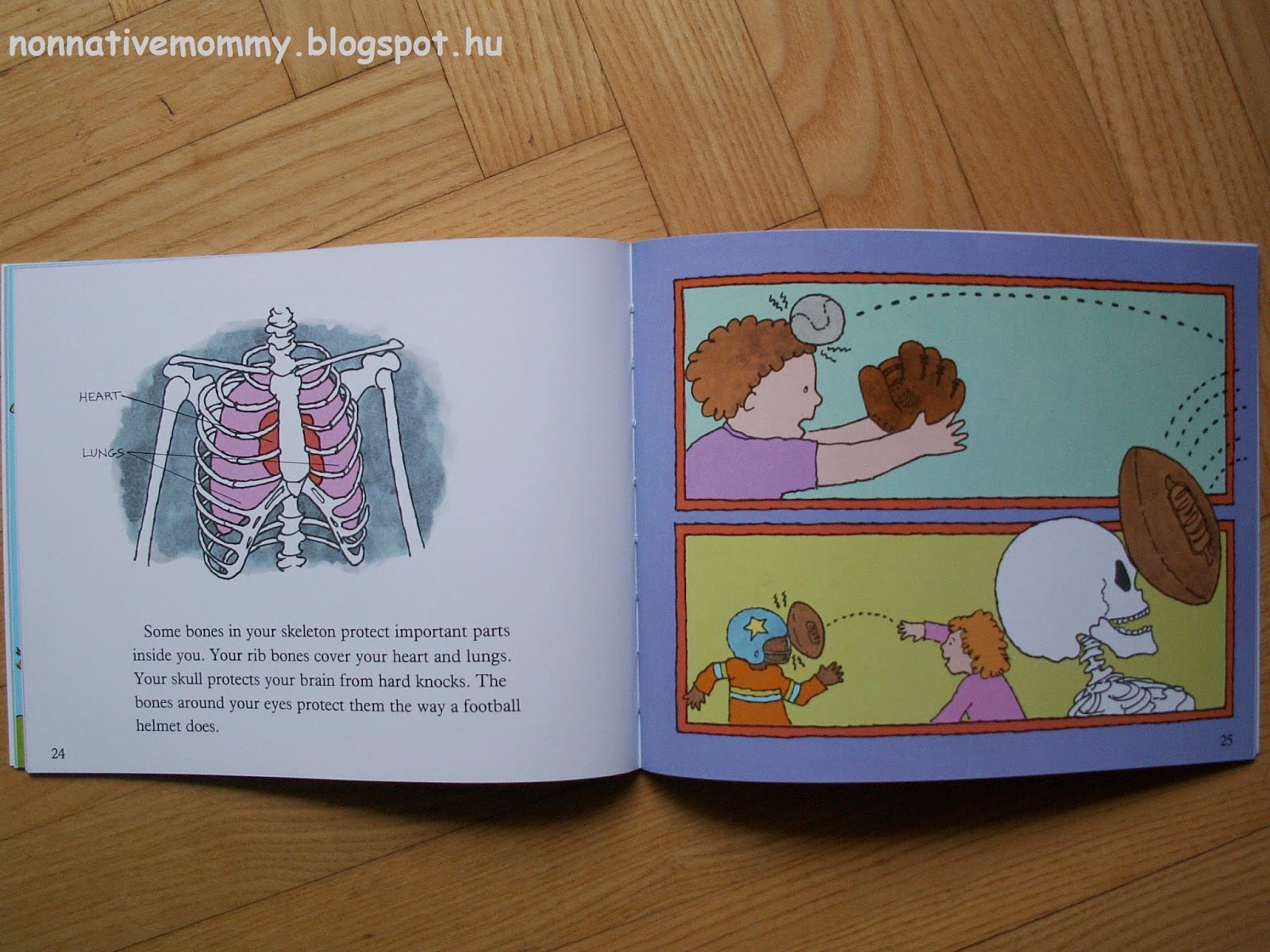
The book - The skeleton inside you


It's a funny book with a lot of information on bones. When it says "your skeleton helps you run, jump and stand", I added some more actions (squat, walk slowly, sit, roll, make a bridge, kick, clap etc.)
 and E. needed to do what I said. She enjoyed it a lot.

You have 32 bones in your arm

the rib cage and the skull protect important organs

Halloween costume skeleton

"Look Daddy, this is the femur"

Skeleton as food
E. was absolutely amazed when she saw this snack on her plate. Since then I need to cut skeletons out of everything.


Last but not least: Skeleton costume for Halloween

These are H&M skeleton pyjamas and gloves


I do not need to comment this. Or if you wish you can read about our MEC Halloween party we had.

I hope you found some ideas useful if your little one is also obsessed with bones and skeletons.


Tuesday, 7 January 2014

Shapes, shapes, shapes - there are all sorts of shapes

E. is into shapes to a great extent. About 2 months ago (when she was 16-17 months old) she already knew all the basic (and some not so basic) shape names. So it made me think what we can do to practise and play with the shapes in more varied ways.

When E. was quite small, around 6-8 months old, we watched and we've still been watching the following videos concerning shapes.

The Shape Song:


Shape Song 2:


Shape song: (I don't really fancy this one, but E. does)


We have some new favourites. While we are watching some of them she bursts out with laughter, like in case of the following:


The next video might seem very monotonous and boring but my daughter loves it and sometimes wants to watch it 4 or 5 times.


There are a lot more videos on shapes but I do not want to bore you. You can search for them on youtube.
E. got a shape cube for her first birthday, but she was totally untouched by it after taking a first look.

Birthday present with potentials
Mostly, I was playing with it and she was watching, or was just playing away next to me. When she was about 14-15 months old, she started to name the shapes out of the blue, much to my surprise.

We also use the shapes of the cube to match shapes in a little bit more different way. I took out a piece of paper and 9 shapes from the cube (I don't know why 9... it could have been 5, 7 or 10. It was a sudden idea.). With the help of a brown crayon I drew them around (E. was watching closely and tried to help a bit too :) )


Then I gave her the shapes and I didn't even have to tell her what to do. She started to put the shapes on the paper.


To initiate more talking I always asked what she was doing, what shape it was she was holding etc. Plus, she sometimes said the colour of the shape, too, all by herself.

Sometimes E. needs motivation to eat. At dinnertime I prepare some 'soldiers' and different shapes carved out of bread, ham, salmon or veggies. It is much more fun for her to eat a pentagon or a triangle than a slice of simple cucumber.


When she turned 16 months we found some books in the library on shapes. This picture dictionary contains two pages of colourful shapes (solids too).


Before taking the book back to the library I had these (and some more pages) photocopied and used the shapes to make flashcards as well.

And a famous favourite (alas, we've got it in Hungarian in the library but this unfortunate fact does not keep me back to use it for other language purposes):

Another Hungarian one: Kun Fruzsina: Formák


Stars
 Last but not least a Baby Einstein book on shapes:

There are tons of books on amazon.com all about shapes. No matter which book you use, but it is another fun way to talk about shapes and see them in different contexts.

Baby's Best Start (Helen Doron beginner baby course 3rd CD)  has a song about shapes. We listen to it twice a day and E. knows it by heart. Also the book contains pages of shapes and objects of a similar kind (circle-sun, triangle-sail, square-book).

Often E. identifies shapes by herself. On the table cloth of our dining table there are some diamond shapes and whenever she walks past she points at them and says: - Little diamond. Here. Big diamond. There.
On the basis of this experience, sometimes we just walk around the house and identify shapes. (The mirror is a rectangle, the washing machine is a cube, the socket is a square and the hair bobble forms a circle etc.) It is also a good idea to collect smaller objects of different shapes in a light box that your child can walk around with. When you have like 10-15 things you can throw them all onto the floor and group them according to their shapes.

For E.'s first birthday I also bought a second hand  Froggy with shapes on his tummy. When you turn it on one of the shapes starts flashing. You need to push the flashing button and the Froggy starts singing a famous nursery rhyme/song (Star - Twinkle, Twinkle, Triangle - Mary had a little lamb, Circle - Pat a cake and so on). Unfortunately, the square does not work any more, so whenever E. tries to make the square work I sing the Helen Doron Shapes song.


As Christmas was here I was planning to do a little christmasy shape fun, but I did not have time to make it. You can find a lovely Christmas tree decoration game with shapes here (ketnyelvugyerek.hu). The description is in Hungarian, but the picture speaks for itself.


Or a similar activity from Super Simple Learning with a template.
Another simple 3D Christmas tree decoration fun:

http://buggyandbuddy.com/christmas-activities-kids-decorate-felt-christmas-tree/

We are going to do all these next year I am sure, as a little revision. ;)

Finally, let me show you a picture of shape chaos after an hour of playing:


Saturday, 26 October 2013

More flashcards - clothes, dogs, birds and more

I coloured the clothes flashcards, but that was the end. I'm not going to colour more cards... I've had enough. So I asked D. to have them printed on the way home from work. And here they are!
I just needed to laminate and cut them up. It was easy-peasy. What's more, they look more professional ;)

So here are some ideas what to do with the clothes cards:

  1. just show them one by one saying their name
  2. show the real items and match them with the card (once I lay down and E. put the clothes cards -the items I was wearing- on me. It was a little chill-out time for me :) this is why I have no picture of this activity)
  3. group them according colour, sex or where we put them on (upper-body/lower-body, feet etc.)
  4. put together matching outfits: white and red hat, red jumper, blue jeans and red boots or orange blouse, yellow skirt and brown sandals (she got some weird combinations too: bra, slippers, tights).
  5. select the ones you can wear in the swimming pool, or what daddy wears at work, what we wear when it rains etc. - kind of situational usage of clothing
I was fed up saying "It's a doggy" while we were walking in the street and saw different breeds of dogs. It must be strange for a child to see a Westie and a Bernese Mountain dog and hear that Mommy calls both of them a dog.

And what we do with the doggie cards:

  1. just show them one by one and say their names
  2. identify the size, colour and length of their fur
  3. group them according to colour, having a tail or not, met them in our area or not
  4. give them dog names (we have the picture of our dog, M. and at Grandma's place she's got a plush dog called Bobby, and a sleeping toy called Morzsi, so after naming all the dogs we know we give the other dogs different names. We've got a lot of Bobbies, some Georges - after Peppa Pig's brother etc.)
  5. pat and stroke (E. picks few dogs and pat them or stroke them, nowadays she started to kiss everybody and everything, so the dogs cannot miss her kisses)
Bird cards: - we haven't used them, but I plan the following activities:
  1. just show them one by one saying their name
  2. identify the colours on them
  3. listen to the sounds they make on youtube (I put together a playlist on youtube with the sounds of the birds - She loved the sound of jays so much she laughed out loud)
Bird cards in autumn light

Household appliances:

I cannot add anything new to the activities we do with these cards. Sometimes E. takes the washing machine card to our washing machine and throws it inside. :)

Insects:

The 'nice', not too disgusting insects

I have made some more cards in the topics we already had as well as new ones. E. loves them but gets bored of them quickly (she knows all the dogs and clothes already...) so we have baby objects, furniture, vehicles and famous building flashcards too. If I have time I'll take photos of them too. However, we do the same things with them. And there are more to come: tools, kitchen utensils, geographical features, famous people, paintings - just to mention some which are on my mind.
Related Posts Plugin for WordPress, Blogger...